 Request a quote
Consultant comments on joinery and millwork shop drawings: how to respond, revise and resubmit
A practical way to sort, log and answer consultant comments, revise the drawings and resubmit clearly. Written for joinery and millwork contractors, workshops and design firms.
Expect comments, and treat each one on its merits
When joinery or millwork shop drawings come back from the consultant, expect comments. Some are normal coordination questions. Some are required corrections. Some need a design decision, and some raise technical issues that stay open until the right people agree an answer. Not every comment is minor, and not every one is routine.
The risk is a slow or untracked response that brings the same questions back in a second round. This guide sets out a practical way to sort comments, log them, revise the drawings and resubmit clearly, for projects in the GCC, USA, Canada, UK and Australia. It describes general good practice: your contract and the consultant’s instructions always come first.
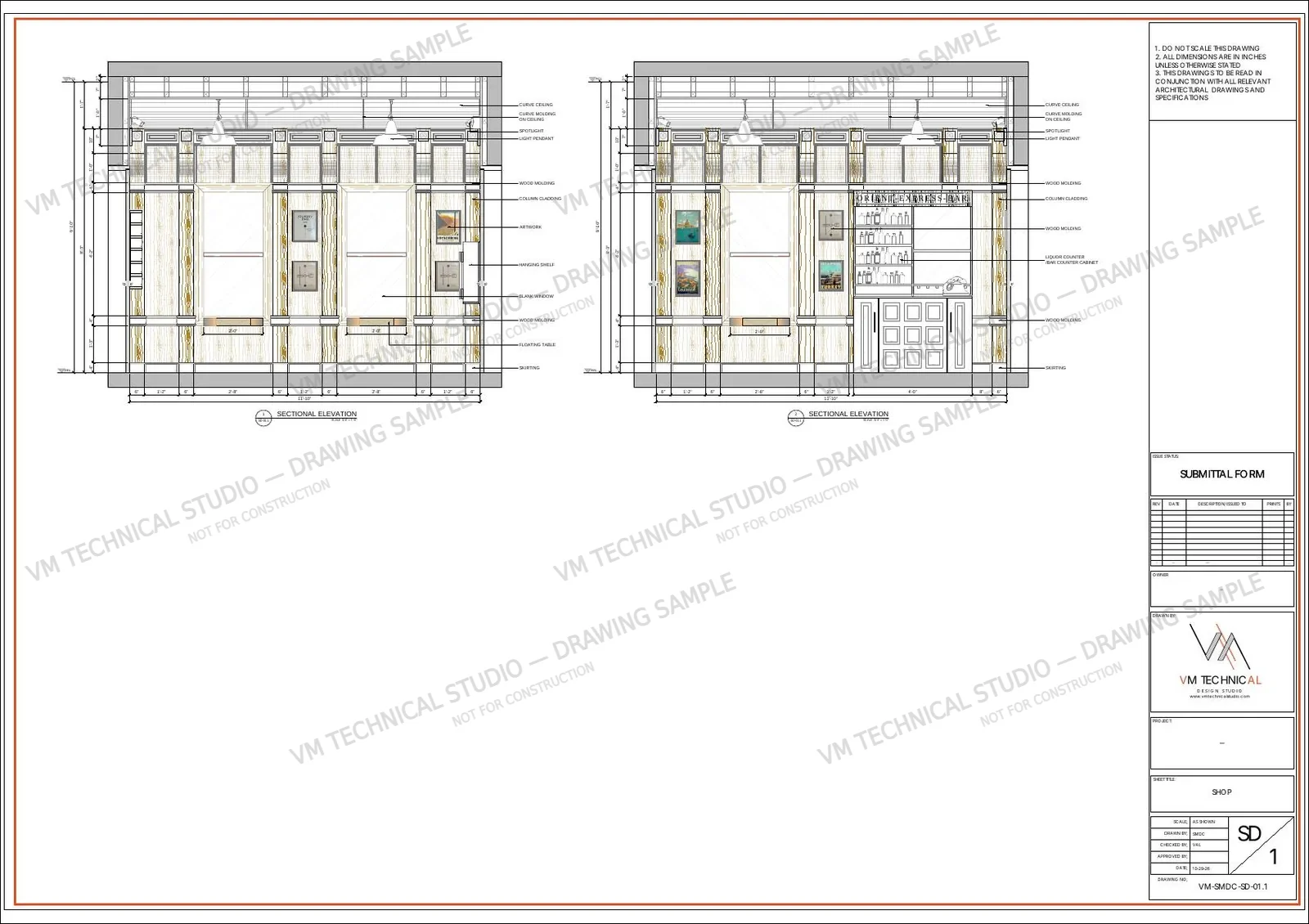
Watermarked sample sheet. See more approved previews.
What comes back: read the status first
Reviewers return drawings with a status and comments. The wording differs from project to project. Some use “Approved”, “Approved with comments” and “Revise and resubmit”; others use letter codes or their own phrases. Use the status codes in your own project documents.
Whatever the wording, the question that matters is whether fabrication may proceed. That is set by the project’s contract documents and the instructions of the responsible reviewers, not by the drafter. If the status or its effect is unclear, ask before anything is released to the workshop.
Step 1: sort the comments before redrawing anything
Read the whole return, then put each comment in one of five groups:
- Drawing corrections: a dimension, label, material reference or detail to change.
- Clarifications: the drawing is right, but the reviewer needs a written answer.
- Design decisions: choices that belong to the architect or interior designer, such as a finish, a profile or a layout change.
- Scope or cost changes: a comment that adds work beyond what was priced. These go to the contractor’s commercial team.
- Conflicts and open technical issues: a comment that contradicts another comment, another discipline’s drawing or the specification, or that cannot be resolved without further input.
Corrections and clarifications can usually be handled by the drawing team. Design decisions, scope changes, conflicts and open technical issues should go back to the responsible person, with the sheet and detail marked, rather than being absorbed silently.
Step 2: keep a comment log
A comment log is a simple table that travels with each issue. For each comment it records what was said, what was done and where. Responses should show clearly whether a comment led to a drawing correction, was answered as a clarification, or is awaiting approval or a decision.
| Ref | Sheet / detail | Comment (as received) | Type | Response | Rev. | Status |
|---|---|---|---|---|---|---|
| 01 | Sheet 3, section A | Confirm fixing to wall | Clarification | Fixing method stated in the response and noted on the detail | B | Answered |
| 02 | Sheet 5, elevation | Panel height does not match the dimension on the plan | Drawing correction | Dimension revised and schedule updated | B | Revised |
| 03 | Sheet 2, plan | Finish to be confirmed by designer | Awaiting approval | Query sent to the designer | — | Open |
Illustrative example only. It is not taken from any client project.
- Number every comment and copy its wording exactly as received.
- Give each comment one clear response, even if the response is “query sent”.
- Log design decisions, scope changes and conflicts as awaiting approval until the responsible person decides.
- Keep open items visible until they are closed, and never delete a line.
- Keep the log with the drawing issue it relates to.
Preparing and maintaining a comment log is part of our drafting service where it is included in the agreed scope.
Step 3: revise the drawings
- Revise every affected sheet, not only the marked one. A changed dimension can affect elevations, sections, schedules and parts lists.
- Mark every change with revision clouds, revision identifiers and title-block records, following the client’s or consultant’s agreed drawing standards.
- Change only what was asked. If you discover an additional correction, document it and coordinate it with the responsible reviewer instead of changing it without explanation.
- Re-check against the latest design information before resubmitting, including any new architectural revision or instruction received since the last issue.
- Check for knock-on conflicts. Fixing one comment can create a new problem elsewhere in the set.
Step 4: prepare the resubmission
Follow the submittal procedure in your project documents. As a general rule, a clear resubmission includes:
- a cover or transmittal sheet showing the project, the item, the new revision, the date and the previous submission it replaces;
- the comment log or response sheet, with every comment answered;
- a list of the sheets that changed;
- any deviation or substitution, declared openly with the reason, rather than left for the reviewer to find;
- the same format and file naming as the first submission, unless the reviewer asks otherwise.
Who does what
- Contractor: manages the submission route, decides the commercial impact of comments, verifies site dimensions and remains responsible for the information issued to site.
- Workshop: confirms that the details can be built with the materials and hardware chosen.
- Drafting partner: updates the drawings from the comments supplied, within the agreed scope, flags questions and conflicts, and issues consistent revisions.
- Consultant or designer: makes design decisions and approves.
Agree one named contact on each side, and send questions together in one list with the drawing location marked, rather than scattered across emails.
Comments on GCC and international projects
Projects in the GCC and elsewhere often involve several reviewers. Depending on the project, the interior designer, the main contractor, the client’s representatives, building management or other consultants may all comment, and their comments are not always consistent. Some practical points:
- Ask for one consolidated return where possible. If that is not available, log conflicting comments and send them back for a decision.
- Use the client’s or consultant’s status wording, templates and title block. A drafting partner can work to them when they are supplied at the start.
- Agree units and sheet sizes at the start. Projects differ, and a change in the middle of a revision cycle causes errors.
- Agree how comments will be exchanged. A marked-up PDF or a comment sheet works well across time zones, with return times agreed in advance.
Why second rounds of comments happen
Repeated comments often come from a few avoidable causes: a comment was only partly answered, a change that fixed one comment created a conflict elsewhere, or a change was made that nobody had asked for and nobody declared. A comment log and a full re-check before resubmitting help reduce avoidable omissions and repeated comments.
They cannot guarantee approval. A reviewer may raise new points on a resubmission, and the decision to approve always rests with the responsible reviewers.
What VM Technical Studio does, and does not do
We are a project-based outsourced technical drafting partner, coordinated from Jeddah, Saudi Arabia, with a Philippines-based drafting team.
Depending on the agreed scope, we:
- update joinery and millwork shop drawings from the consultant comments you supply;
- prepare and maintain a comment log and issue tracked revisions;
- flag design decisions, scope changes and conflicts back to you instead of deciding them;
- deliver DWG and PDF, depending on the agreed project scope.
We do not:
- approve drawings, give licensed engineering sign-off, or promise that a submission will be approved;
- verify site dimensions or take over the contractor’s responsibility for the information issued to site.
Delivery schedules depend on the agreed project scope and team availability, and are confirmed before work starts. Our Urth Caffé case study is an existing Portfolio example of a full numbered shop drawing set with site progress photographs. Approved, watermarked previews are on our Portfolio; additional samples are available on request, subject to client confidentiality and approval.
Frequently asked questions
Can you update our drawings from consultant comments?
Yes, depending on the agreed scope and on the legibility and completeness of the comments supplied. A marked-up PDF or a comment sheet is the best starting point.
Will you decide how to resolve a design comment?
No. Design decisions stay with the designer and the responsible professionals. We flag them back to you with the drawing location marked.
What if two reviewers’ comments conflict?
We log both, mark the affected drawing location and send the conflict back for a decision, rather than choosing one silently.
Does an approval status mean we can proceed?
Approval statuses, design changes and permission to proceed must follow the project’s contract documents and the instructions of the responsible reviewers. If the status or its effect is unclear, ask the reviewer or your contract administrator before releasing work.
What should I send when asking for revisions?
The latest drawings in DWG, the consultant’s returned comments, the previous issue’s log if there is one, and any new design information received since.
How do I get started?
Send a short brief and the returned comments through the quotation form or on WhatsApp at +966 565 362 134. We confirm scope and quote clearly before drafting starts.
Related services and guides
See our Joinery & Millwork Shop Drawings service and Outsourced CAD Drafting service, our guide to joinery, millwork and casework shop drawings, and our guide to outsourced CAD drafting.
Drawings back with comments?
Send the files and the returned comments. We will confirm scope and quote clearly. Call or WhatsApp +966 565 362 134.